Successful Campaigns
Read about some of our recent campaign wins, such as the reinstatement of the Veterans' Mobility Fund.
15 years after the end of the Iraq War, codenamed Op TELIC, we examine its history and honour those who served there.
On 22nd May, 2011, the last of the UK's troops withdrew from Iraq, following the Middle East conflict fought there from 2003 to 2011. It was codenamed Operation TELIC.
140,000 British Armed Forces personnel served during the operation, and a total of 179 were killed. Thousands more were wounded, and many veterans live with the physical, mental and emotional impact of their service. In direct response to the lack of proper government support for those returning with severe injuries, from both Iraq and Afghanistan, Help for Heroes was launched.
After the 11 September 2001 attacks, US President George W. Bush declared that Saddam Hussein’s Iraq posed a threat through alleged links to terrorism and claims that it held weapons of mass destruction (WMD). The UK Prime Minister at the time, Tony Blair, backed calls for Iraq to disarm.
Already under United Nations (UN) restrictions tied to suspected WMD programmes after the first Gulf War, Iraq was given a "final opportunity" to cooperate with weapons inspectors in November 2002, after the UN Security Council passed Resolution 1441. Inspectors returned, but the US and UK said compliance fell short, while France, Germany and others urged more time.
On 17 March 2003, without a further UN resolution, the US and allies gave Saddam Hussein and his sons 48 hours to leave Iraq.
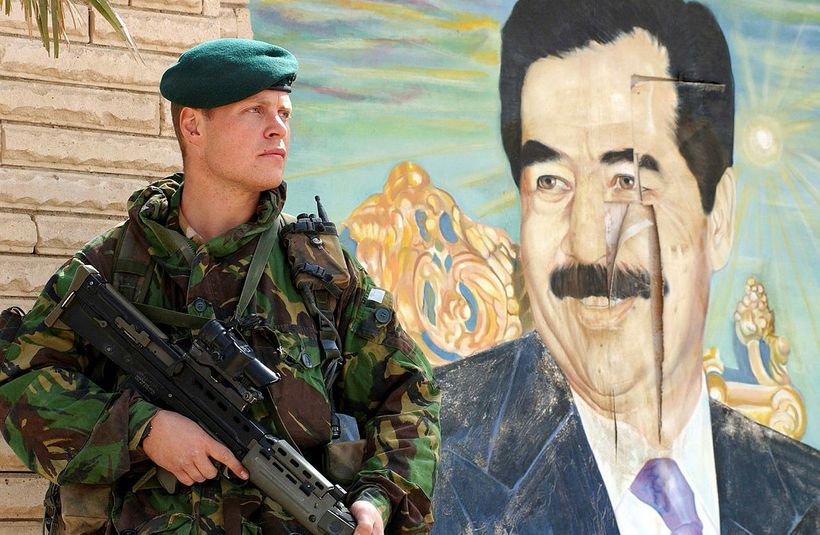
The invasion began on 20 March 2003, with air strikes and a rapid ground advance from Kuwait. UK forces led operations in the south, including Basra. Baghdad fell in early April and major combat operations were declared over on 1 May. Saddam Hussein himself was captured in the December.
But stability did not follow. State authority collapsed, post-war planning was limited, and decisions to disband much of Iraq’s armed forces and exclude many Ba’ath Party members helped drive a growing insurgency.
In 2004, sovereignty passed to an interim Iraqi government, but violence continued. Elections in 2005 and a new constitution failed to ease deepening sectarian tensions, which escalated after the al-Askari shrine bombing in Samarra in February 2006.
Saddam Hussein was executed on 30 December 2006. No chemical or biological WMD stockpiles were found, fuelling lasting controversy. British troops remained in the south under Operation TELIC.
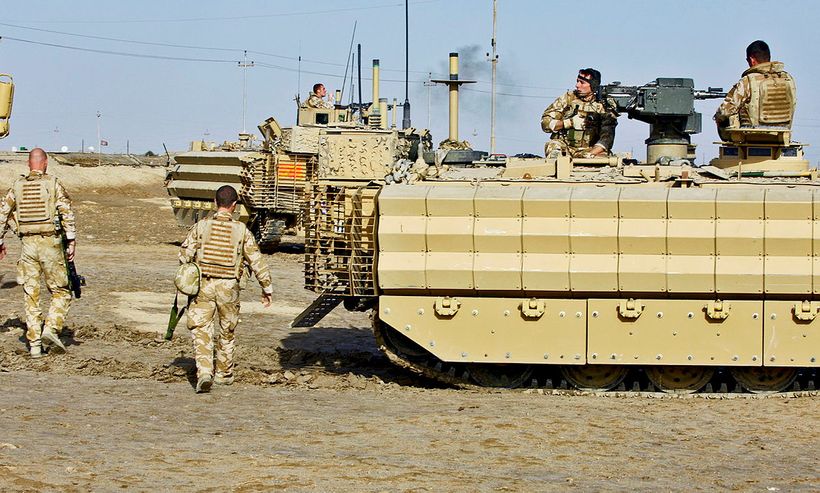
British forces undertook a prolonged stabilisation mission across four provinces, running bases, patrols and checkpoints and supporting efforts to restore services and local policing, often in harsh conditions.
Violence had intensified in 2005, with deadly attacks on British troops and personnel in and around Amarah and Basra.
As parts of the local police were infiltrated and some areas became effectively out of bounds, British forces relied more on surveillance and intelligence-led raids, often with local interpreters. By mid-2006, militias were increasingly organised and well-armed; on 6 May 2006, a British Lynx helicopter was shot down over Basra, killing all five UK service personnel on board.
By late 2008, as attention shifted to Afghanistan, Prime Minister Gordon Brown confirmed the timetable for UK withdrawal. A ceremony at Basra International Airport on 30 April 2009 commemorated British, allied and civilian lives lost since 2003.
The UK’s main combat mission ended in May 2009, and the last Operation TELIC personnel left Iraq in May 2011.
In the UK, the decision to invade remained highly contentious and Tony Blair's government was examined in a lengthy official inquiry.
Governments, politicians, policies all change with alarming regularity. What those affected by their service to our nation need is consistency of care, support and understanding.”
Founding Member of Help for Heroes and former Grenadier Guards
*Content warning: descriptions of scenes of war and death*
Gareth Collett spent more than three decades walking towards danger. As one of the Army’s leading bomb disposal experts, he became used to the so-called “long walk”. The nerve-shredding, solitary approach to a suspected explosive device that could end his life in an instant but save dozens of others.
Rising to the rank of Brigadier, Gareth served in Northern Ireland, Kosovo, Afghanistan and, of course, Iraq. In these places, he dismantled weapons, commanded multi-national bomb disposal teams, oversaw the exhumation of mass graves and advised allies. His experiences left him with the invisible wounds of post-traumatic stress disorder (PTSD).
At the scene of one of many large market bombs in Iraq, there were broken bodies everywhere. My senses couldn’t really take that in. Three days later I went back to my family and had to pretend nothing had happened.”
Army veteran
After his retirement in 2018, ongoing PTSD - including horrendous nightmares - plagued Gareth and his family. Salvation came through a Special Forces friend in 2023, who suggested he get in touch with Help for Heroes’ Hidden Wounds programme.
Gareth has gone on to achieve a great many things. He leads the UK's only munitions and explosives apprenticeship course at the University of Wales Trinity Saint David and has completed a PhD on regulating the chemicals used to make improvised explosives – work inspired partly by the 2017 Manchester Arena bombing. His findings have been adopted by the UN and Interpol. He received a CBE from the late Queen, has launched a new business combining explosive engineering science with nature-based design to improve protective infrastructures, and recently signed a book deal about his extraordinary career and life.
“We have a bow wave of people affected from Iraq and Afghanistan all walking into an NHS system already overburdened with problems they may not understand," Gareth says. "Combat changes people, that you know, and those changes are not always visible.
“Remembering wars like Iraq is important, as it is the only thing that people who have not been in combat can do. They enjoy the privilege of freedom and it's important that that's acknowledged and recognised.”
Simon ‘Si’ Brown grew up in Morley, West Yorkshire, and joined the Army aged 18. On his second tour of Iraq in 2006, serving with the Royal Electrical and Mechanical Engineers, he was called to rescue a stranded vehicle with a crew of six on board, following an insurgent attack. During the extraction, he was shot in the face by a sniper.
He suffered horrendous injuries; a broken jaw in four places and a collapsed palate, which he held open with his own thumb all the way back to base. Airlifted back to the UK in an induced coma, he ultimately lost his left eye, nasal cartilage and had only 20% vision remaining in the right eye.
He was supported by Help for Heroes during the earliest days of the charity; his family being put up in a flat near the hospital for use during his extensive treatment - and where Si himself found some respite from a busy and triggering hospital environment. He remains a Help for Heroes ambassador to this day.
I've done my best to move forward. My whole life now is about living the moment because, you know, I can speak with more authority than most on that. Tomorrow's not a guarantee."
Veteran and Help for Heroes ambassador
Since Iraq and his injury, Simon, like Gareth, has gone on to great things. He played rugby for Leeds Rhinos, captaining the club to double national victory in his final year, before coaching in the Physical Disability Rugby League and supporting their Paralympic pathway. He has completed treks across the Sahara Desert and Costa Rican jungle, carried the Olympic torch at London 2012 and is employed by Blind Veterans UK. But it doesn't stop there. An elected Leeds City councillor and motivational speaker, Si became the Mayor of Morley in 2024-25, before overcoming MRSA, sepsis and a collapsed lung in February 2026.
"I’m not someone who does half a job. I’m serving my community. I’ve just got a microphone and a laptop instead of a rifle. I'm very, very content with the place I’m in now. I wouldn't be this person had I not been through what I’ve been through.
"The Iraq War was just part of the journey for me, but with any adversity, you come out of it with two options: you move forward, or you sit and just fall apart. I've done my best to move forward."
The need for Help for Heroes’ life-changing care grows in an increasingly dangerous and uncertain world.
It has led to the launch of the ‘People’s Promise to Veterans’ campaign, aimed at ensuring all veterans receive the support they need after service, focusing on healthcare, financial security and consistent access to that support.
It takes an average of 12.5 years for veterans to reach out to us.
It is never too late to ask for help.
Can you support us in helping all veterans live well after service? Your donations will help veterans get the help they deserve.