



The first Gulf War - Causes, Events and Impact
Updated on
An overview of the first Gulf War, covering how it began, the countries involved, and how long it lasted.
Updated on
On 22 May, 2011, the last of the UK's troops withdrew from Iraq, following the Middle East conflict fought there from 2003 to 2011. It was codenamed Operation TELIC.
140,000 British Armed Forces personnel served during the operation, and a total of 179 were killed. Thousands more were wounded, and many veterans live with the physical, mental and emotional impact of their service. In direct response to the lack of proper government support for those returning with severe injuries, from both Iraq and Afghanistan, Help for Heroes was launched.
After the 11 September 2001 attacks, US President George W. Bush declared that Saddam Hussein’s Iraq posed a threat through alleged links to terrorism and claims that it held weapons of mass destruction (WMD). The UK Prime Minister at the time, Tony Blair, backed calls for Iraq to disarm.
Already under United Nations (UN) restrictions tied to suspected WMD programmes after the first Gulf War, Iraq was given a "final opportunity" to cooperate with weapons inspectors in November 2002, after the UN Security Council passed Resolution 1441. Inspectors returned, but the US and UK said compliance fell short, while France, Germany and others urged more time.
On 17 March 2003, without a further UN resolution, the US and allies gave Saddam Hussein and his sons 48 hours to leave Iraq.
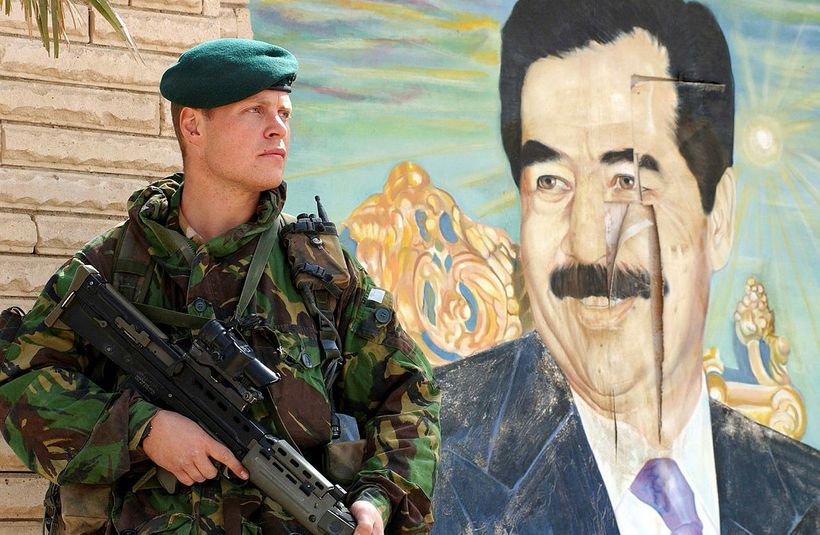
The invasion began on 20 March 2003, with air strikes and a rapid ground advance from Kuwait. UK forces led operations in the south, including Basra. Baghdad fell in early April and major combat operations were declared over on 1 May. Saddam Hussein himself was captured in the December.
But stability did not follow. State authority collapsed, post-war planning was limited, and decisions to disband much of Iraq’s armed forces and exclude many Ba’ath Party members helped drive a growing insurgency.
In 2004, sovereignty passed to an interim Iraqi government, but violence continued. Elections in 2005 and a new constitution failed to ease deepening sectarian tensions, which escalated after the al-Askari shrine bombing in Samarra in February 2006.
Saddam Hussein was executed on 30 December 2006. No chemical or biological WMD stockpiles were found, fuelling lasting controversy. British troops remained in the south under Operation TELIC.
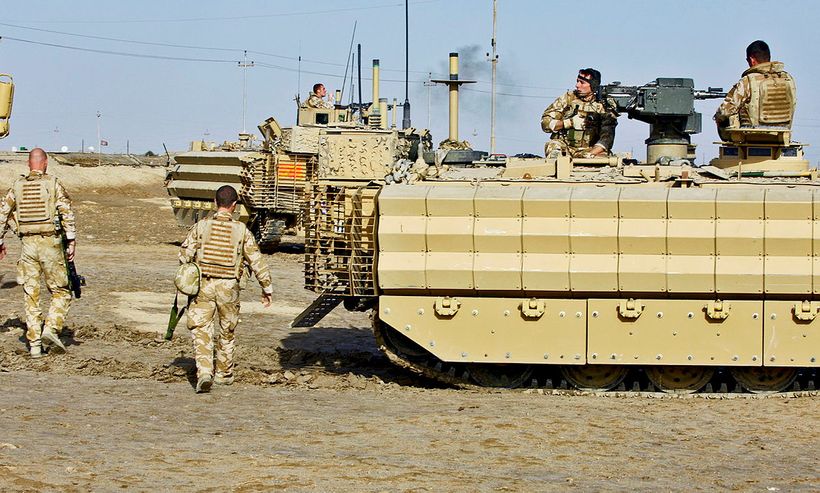
British forces undertook a prolonged stabilisation mission across four provinces, running bases, patrols and checkpoints and supporting efforts to restore services and local policing, often in harsh conditions.
Violence had intensified in 2005, with deadly attacks on British troops and personnel in and around Amarah and Basra.
As parts of the local police were infiltrated and some areas became effectively out of bounds, British forces relied more on surveillance and intelligence-led raids, often with local interpreters. By mid-2006, militias were increasingly organised and well-armed; on 6 May 2006, a British Lynx helicopter was shot down over Basra, killing all five UK service personnel on board.
By late 2008, as attention shifted to Afghanistan, Prime Minister Gordon Brown confirmed the timetable for UK withdrawal. A ceremony at Basra International Airport on 30 April 2009 commemorated British, allied and civilian lives lost since 2003.
The UK’s main combat mission ended in May 2009, and the last Operation TELIC personnel left Iraq in May 2011.
In the UK, the decision to invade remained highly contentious and Tony Blair's government was examined in a lengthy official inquiry.
Governments, politicians, policies all change with alarming regularity. What those affected by their service to our nation need is consistency of care, support and understanding.”
Founding Member of Help for Heroes and former Grenadier Guards
The need for Help for Heroes’ life-changing care grows in an increasingly dangerous and uncertain world.
It has led to the launch of the ‘People’s Promise to Veterans’ campaign, aimed at ensuring all veterans receive the support they need after service, focusing on healthcare, financial security and consistent access to that support.
It takes an average of 12.5 years for veterans to reach out to us.
It is never too late to ask for help.
Updated on
An overview of the first Gulf War, covering how it began, the countries involved, and how long it lasted.
Updated on
All about the Afghanistan War, including how it began, who was involved and how long it lasted.
Updated on
Explore the key events and impact of World War One, and how the first global conflict changed the world
Updated on
The key events which took place in the World War II, including the cause of the war and the impact it had worldwide.